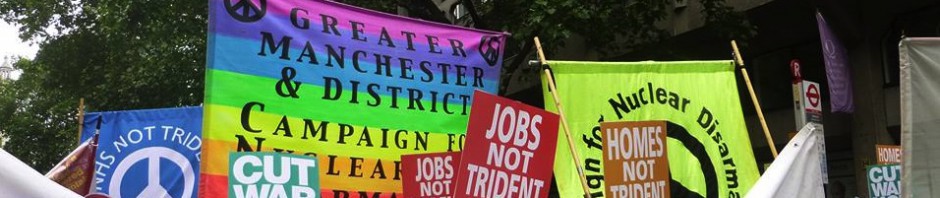
Please join the Lord Mayor of Manchester and Vice-President of Mayors for Peace, Council Paul Andrews, at these events in the world’s first declared nuclear free city.

In 1945, the United States Air Force dropped atomic bombs on the Japanese cities of Hiroshima and Nagasaki with tragic and devastating consequences. Hundreds of thousands of people died, many instantaneously, others soon after from burns and shock, and yet more from the impact of radiation in the months and years that followed. By 1950, an estimated 340,000 people had died as a result of the two bombs.
The city of Hiroshima stands on a flat river delta on the Japanese mainland, Honshu. At quarter past eight on the morning of 6 August 1945, the US plane Enola Gay dropped an atomic bomb on the city centre, a busy residential and business district, crowded with people going about their daily business. The bomb, called ‘Little Boy’ because of its long, thin shape, was made from uranium-235. Unimpeded by hills or natural features to limit the blast, the fireball created by that single bomb destroyed 13 square kilometres of the city.
The heart of the explosion reached a temperature of several million degrees centigrade, resulting in a heat flash over a wide area, vaporising all human tissue. Within a radius of half a mile of the centre of the blast, every person was killed. All that was left of people caught out in the open were their shadows burnt into stone. Beyond this central area, people were killed by the heat and blast waves, either out in the open or inside buildings collapsing and bursting into flame. In this area the immediate death rate was over 90 per cent. The firestorm created hurricane-force winds, spreading and intensifying the fire. Almost 63 per cent of the buildings of Hiroshima were completely destroyed and nearly 92 per cent of the structures in the city were either destroyed or damaged by the blast and fire. The total number of deaths was hard to establish, but at least 75,000 died in the first hours after the bomb was dropped, with around 140,000 dead by December 1945. The death toll reached around 200,000 by the end of 1950.
On 9 August, the US dropped a second atom bomb on the Japanese city of Nagasaki. This bomb, named ‘Fat Man’ because of its rounder and fatter shape, was more powerful than that dropped at Hiroshima and was made from plutonium-239. Nagasaki is a city built on hills, which affected the immediate impact of the bomb. The explosion took place in the Urakami valley, which meant that the physical destruction of that area was even greater than at Hiroshima. Other parts of the city, however, were shielded to some extent by hills.
Around 23 per cent of Nagasaki’s buildings were destroyed by the blast and fire and over 40,000 deaths occurred in the first few seconds. 70,000 people were dead as a result of the bomb by the end of 1945, and around 140,000 by the end of 1950. Virtually every living thing within three-fifths of a mile from the centre of the blast was immediately destroyed. Beyond this central area, people died in a similar pattern to Hiroshima, from the impact of fire, falling buildings and untreated burns and other injuries, depending on their distance from the centre of the blast.
When the US dropped atomic bombs on Hiroshima and Nagasaki, the cities were obliterated. By 1950, over 340,000 people had died as a result and generations were poisoned by radiation.
Today 13,000 nuclear weapons still threaten our survival, even though the majority of people in the world and their governments support an international ban on their development and use. Nuclear rhetoric around the wars in Ukraine and Gaza has showed us how these weapons can make a dangerous situation even riskier. The possibility of nuclear war is the greatest for many decades.
Join us on 6th and 9th August – at Lincoln Square Gardens at 1pm and Heaton Park at 10.45am respectively – to show that we have not forgotten, and nor will we let history repeat itself.
Local peace groups will also be holding their own events in their area:
- Glossop Peace Group will hold a Vigil in Norfolk Square at 10.30am on Saturday August 10th Remember Hiroshima and Nagasaki! No US Nukes in Britain! UK Join the UN Nuclear Ban Treaty!
- Rochdale and Littleborough Peace Group will hold an event at Hollingworth Lake, Littleborough, on August 6th from 7pm.


